Choosing the best wireless intruder alarm is rarely straightforward, because most systems promise much the same things: app control, instant alerts and a quick installation. The features that genuinely matter tend to sit beneath the surface, in how reliably a system performs and how well it resists interference and tampering. The right choice depends on your property, the level of protection you need and how you prefer to manage your security day to day.
At Gold Standard Security Scotland, we install Ajax wireless alarms. This guide explains the qualities we look for in a wireless alarm system, and why Ajax meets them, so you can compare your options with confidence whether or not you choose us to carry out the work.
How to Choose the Best Wireless Intruder Alarm
A wireless burglar alarm is only as good as its weakest link, so it helps to judge any system against a consistent set of criteria rather than the marketing around it. These are the same criteria our engineers apply on every intruder alarm installation we carry out. The points that make the most practical difference are:
- Signal reliability, meaning a dedicated communication method between the devices and the hub rather than a dependence on home Wi-Fi
- Protection against jamming and tampering, so the system cannot be quietly disabled
- Self-monitoring, where the system continuously checks that every device is connected and powered
- Clear alerts, delivered promptly and in a form you can act on
- A full range of detectors, so one system can protect the whole property
- Professional monitoring options, for households that want a response when they cannot answer an alert themselves
Our guide to intruder alarm grades explains how the grades differ and which one your property needs. Ajax was designed around these priorities, which is the main reason we fit it. The sections below look at each in turn.
How Ajax Wireless Alarms Work
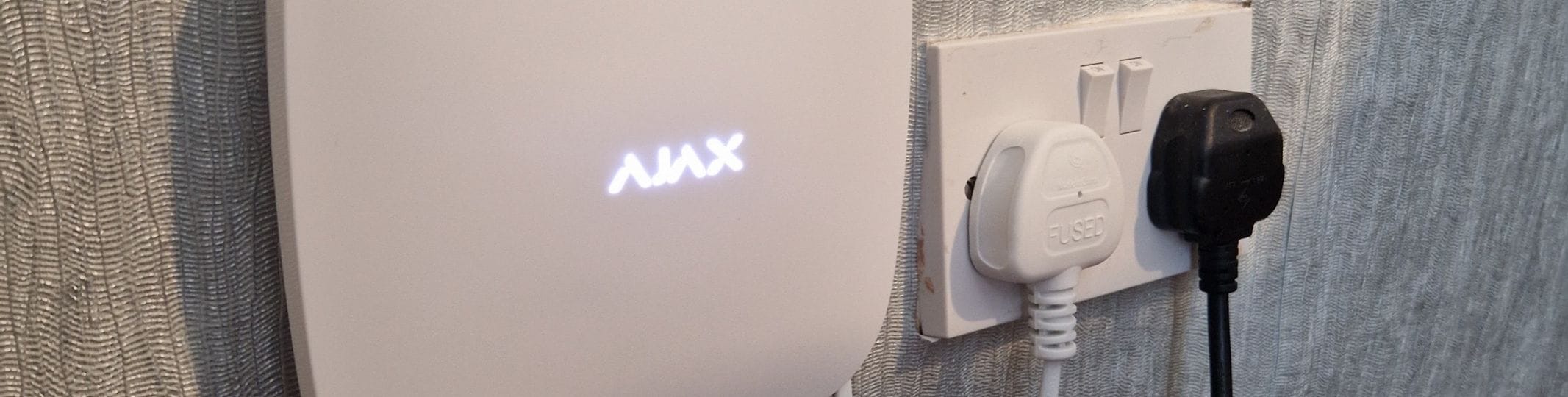
An Ajax system is built around a central hub that communicates with each wireless device, such as motion detectors, door contacts and keypads, over its own radio protocol. This connection is separate from your home Wi-Fi, which means the alarm continues to function even if your broadband drops, and the devices are not competing with phones and laptops for bandwidth. Ajax states that its devices can communicate with the hub at a range of up to 2,000 metres in open, unobstructed conditions. Inside a building the practical range is considerably shorter, because walls and floors reduce the signal, which is one of the things we assess during the survey.
Because the system is wireless, installation is quicker and less intrusive than a wired alarm, with no need to run cabling through walls and floors. For most homes, this means the work is completed with minimal disruption and little or no making good afterwards.
The Security Features That Set Ajax Apart
The difference between a capable wireless alarm and a basic one usually comes down to how it protects itself.
Protection against jamming and tampering
A determined intruder may attempt to block the radio signals a wireless alarm relies on, a technique known as jamming. Ajax hubs are designed to detect interference of this kind and raise an alert rather than fail silently. Devices are also tamper-protected, so an attempt to open or remove one triggers the system. Together, these features address the most common weakness people worry about with wireless alarms.
A system that monitors its own health
Ajax devices report their status to the hub at regular intervals, as often as every 12 seconds on current hubs, covering connection strength and battery level. If a detector loses contact or a battery runs low, the system flags it, so faults are identified before they become a gap in your protection. This continuous self-checking is one of the practical advantages of a modern wireless system over older equipment.
Secure communication
Communication between Ajax devices and the hub is encrypted, which prevents the signals being intercepted or imitated. For most homeowners, the reassurance is simple: the system is built to make interference and spoofing difficult.
The Ajax Detector Range
One of the strengths of a single Ajax system is that it can cover a whole property using a range of detectors suited to different risks. The most common are set out below.
Motion detectors
Interior motion detectors cover rooms, hallways and other spaces an intruder would need to pass through. Pet-tolerant options are available, which are designed to ignore animals below a certain size so a cat or dog does not trigger a false alarm.
Door and window contacts
Contact sensors detect a door or window being opened, providing an early warning at the perimeter of the property before an intruder is fully inside. These are often used on the most likely points of entry.
Glass-break and additional sensors
Glass-break detectors respond to the specific sound of breaking glass, which suits properties with large windows or patio doors. The same system can also incorporate smoke, heat and flood detectors, so a single hub and app can watch for a break-in and for household risks such as fire or a burst pipe at the same time.
App Control, Alerts and Monitoring
Ajax systems are controlled through a free app, with no ongoing charge for app access itself. You can arm and disarm the system remotely, check its status, and receive a notification the moment a detector is triggered. For many households, this level of visibility is enough on its own.
Where a property needs a guaranteed response rather than a notification the owner may miss, the system can be connected to professional monitoring through our NSI Gold accredited alarm receiving centre. A monitoring team then follows an agreed plan when the alarm activates, which can include contacting your keyholders and, where appropriate, notifying the police. Whether monitoring is worthwhile depends on the property and how it is used, and it is something we are happy to talk through rather than add by default.
Looking After Your Alarm: Servicing and Maintenance
A wireless alarm is not a fit-and-forget purchase. Like any security system, it performs best when it is looked after, and a small amount of regular maintenance keeps it dependable for years. Detector batteries need replacing periodically, sensors should be checked for anything that might obstruct them, firmware benefits from staying up to date, and the system should be tested from time to time to confirm every device still communicates and responds as it should.
For a monitored system, maintenance is often more than good practice. Alarms connected to a monitoring centre are typically serviced twice a year to keep that cover in place, and one of those inspections can often be carried out remotely. Many home insurance policies carry a similar servicing condition. Keeping to a maintenance schedule is what ensures the system is still doing its job on the day it matters most.
This is one area where a system like Ajax has an advantage. Because the hub continuously reports the status of every device, many checks can be carried out remotely, which reduces the number of on-site visits needed. When a visit is required, it tends to be quicker, because the issue is often already known before the engineer arrives.
At Gold Standard Security Scotland, we do not simply install a system and move on. We look after the alarms we fit, with ongoing servicing, remote health checks and support, so your system stays reliable and compliant for the long term. If you are weighing up replacing an ageing system, our guide on why to upgrade to an Ajax wireless alarm covers that case. If you would like to understand what maintenance a particular system needs, it is worth asking before you buy, and we are always happy to explain what is involved.
When a Wireless Alarm May Not Be the Right Choice
A wireless alarm suits most homes and many businesses, but it is not automatically the best answer in every case, and it would be misleading to suggest otherwise. A wired or hybrid system may be more appropriate for a very large property, for premises with an existing wired installation worth retaining, or where a specific insurance requirement or alarm grade points to a particular specification. The most reliable way to know which applies to your property is a survey, where the risks, the layout and any insurance conditions can be assessed together. If a wired or hybrid alarm would serve you better, we will tell you.
Professional Ajax Installation in Glasgow
At Gold Standard Security Scotland, we are an authorised Ajax installer, and our engineers hold official Ajax Academy training. Every intruder alarm installation begins with a free survey, where we assess your property, discuss the level of protection you need, and design a system around it. The work is carried out with minimal disruption, and we make sure you are comfortable using the app before we leave. You can read more about our full range of intruder alarm systems.
Frequently Asked Questions About Wireless Intruder Alarms in Glasgow
Are wireless intruder alarms as reliable as wired systems?
A well-designed modern wireless alarm is highly reliable. Systems such as Ajax use a dedicated radio connection rather than home Wi-Fi, monitor their own devices continuously, and detect attempts to jam or tamper with them. For most homes, this provides dependable protection without the disruption of a wired installation.
Does an Ajax alarm need Wi-Fi to work?
The alarm itself does not rely on Wi-Fi, because the devices communicate with the hub over their own radio protocol. An internet connection, through broadband or a mobile network, is used to send notifications to your app and to communicate with a monitoring centre, so a connection of some kind is recommended for full functionality.
Can I control an Ajax alarm from my phone?
Yes. Ajax systems are managed through a free app, which lets you arm and disarm the system, check its status and receive alerts when a detector is triggered. There is no subscription charge for using the app to control your own system.
Do I need professional monitoring with a wireless alarm?
Not necessarily. Many households are well served by app notifications alone. Professional monitoring adds a team that responds on your behalf when an alarm activates, contacting your keyholders and notifying the police where appropriate, which suits properties where an alert on your phone might be missed. We can advise on whether it is worthwhile for your situation.
Is a wireless alarm suitable for a business as well as a home?
Yes, in many cases. Wireless systems are used in shops, offices and other commercial premises, particularly where a quick installation with minimal disruption is important. Larger or higher-risk sites may benefit from a wired or hybrid system, which a survey will determine.
If you are considering a wireless intruder alarm for your home or business, get in touch via our contact us page, email info@goldstandardsecurityscotland.com, or call 07706 303074 to arrange a free survey and a system designed around your property.